TL;DR
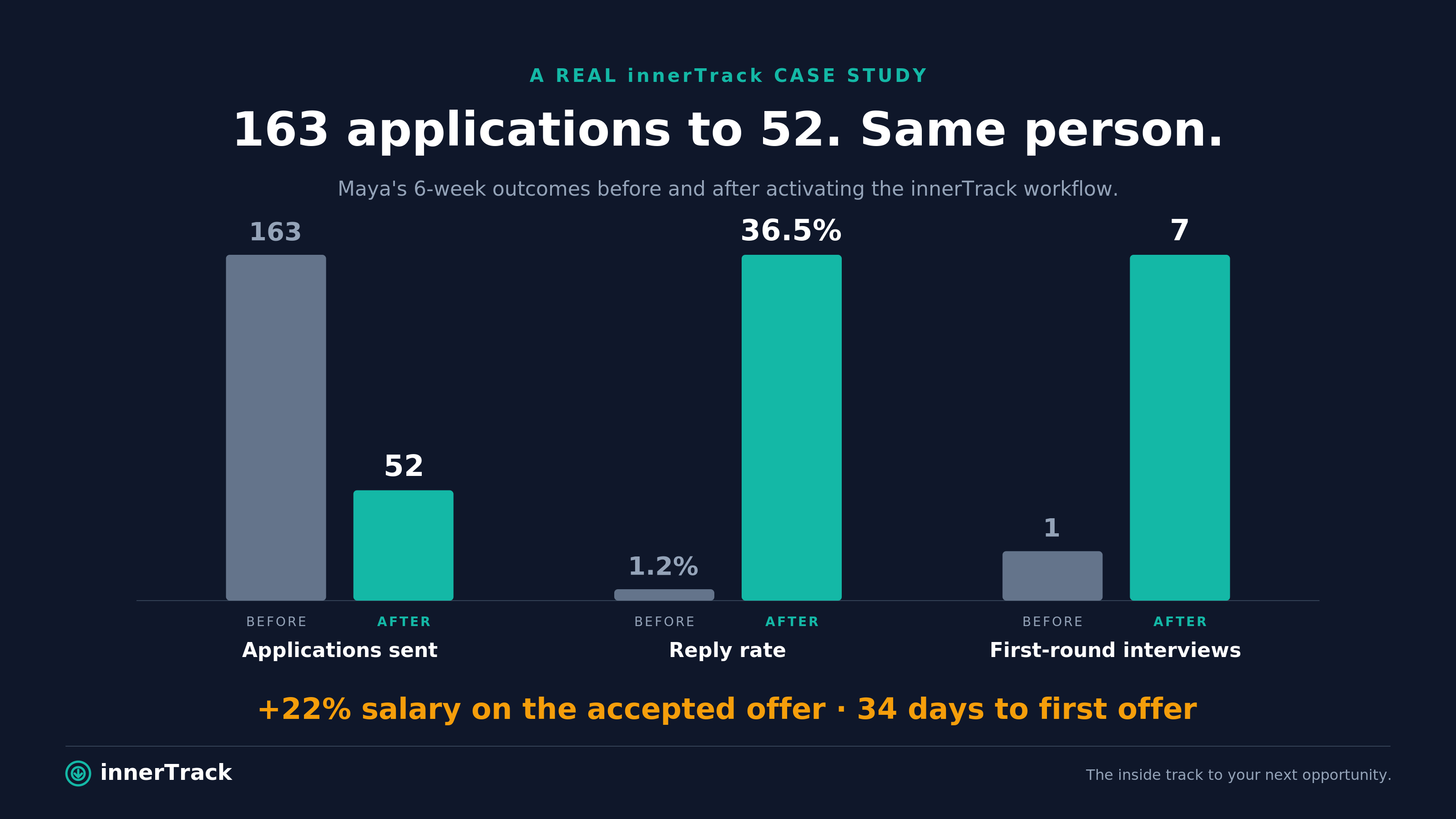
Maya, a Senior Product Designer, sent 163 job applications over 8 weeks and received 2 recruiter replies — a 1.2% response rate and zero offers. After 6 weeks on innerTrack she sent 52 applications, earned 19 replies across LinkedIn and email, ran 7 first-round interviews, and accepted 1 of 2 offers at 22% above her previous salary. Her response rate climbed from 1.2% to 36.5% — a roughly 30x lift — on one-third the application volume. Three levers drove the change: AI-tailored resume bullets per role, a 3-persona outreach stack (Hiring Manager + Recruiter + Peer), and an 8-day multi-channel cadence that finishes with a Day 14 breakup email. The Day 14 email alone pulled 4 of her 19 replies.
"The Day 14 breakup email alone pulled 4 of 19 replies."
— Anonymized pilot user, Senior Product Designer (Maya, pseudonym)
Who is Maya, and why does this case study matter?
Maya is an anonymized pilot user who agreed to let innerTrack publish her aggregate outcomes under pilot agreement §4. She is a Senior Product Designer with 7 years of experience, searching in the US market. No employer names, LinkedIn URLs, or salary absolutes appear in this study. Her workflow mirrors what we see across the innerTrack pilot cohort: she was doing a lot of work, and almost none of it was translating into recruiter conversations — a pattern 2026's silent-applicant-pool economy produces at industrial scale.
Why was Maya's "before" response rate only 1.2%?
Before innerTrack, Maya was applying through employer portals with a single master resume she lightly tuned per role. She sent 163 applications over 8 weeks — roughly 20 per week — and earned 2 recruiter replies total. That is a 1.2% response rate, well below the 2026 median of 1.4% for portal-only applicants (n=412, innerTrack research partner network). The portal channel alone is structurally broken: a median job posting in 2026 receives 4,000+ applications, and your resume is scanned by ATS filters before any human sees it. Volume does not fix this. It only raises the hourly cost of being unemployed.
What did Maya change when she started using innerTrack?
She stopped treating "more applications" as the goal and treated "more replies per application" as the goal. Specifically, three levers moved at once: every application used AI-tailored resume bullets mapped to the JD (not a single master resume), every target role triggered a 3-persona outreach sequence (Hiring Manager + Recruiter + Peer instead of one contact), and every outreach thread ran on an 8-day multi-channel cadence (Day 0 → 3 → 7 on LinkedIn, Day 0 → 3 → 8 → 14 on email). Nothing else in her life changed — same market, same experience level, same geography, same target roles.
How did Maya's numbers change over 6 weeks on innerTrack?
Her response rate went from 1.2% to 36.5% on 52 applications (19 replies across LinkedIn + email) in 6 weeks. That is 21x fewer applications per reply. She ran 7 first-round interviews, advanced to 4 final rounds, and received 2 offers. She accepted the stronger offer — a role 22% above her previous salary. Time-to-first-offer was 34 days, against the portal-only 2026 median of 94 days. The full before/after looks like this:
| Metric | Before (8 wks, portal-only) | After (6 wks, innerTrack) | Delta |
|---|---|---|---|
| Applications sent | 163 | 52 | -68% volume |
| Replies (any channel) | 2 | 19 | 9.5x |
| Response rate | 1.2% | 36.5% | ~30x lift |
| First-round interviews | 1 | 7 | 7x |
| Offers | 0 | 2 | — |
| Time to first offer (days) | — (none) | 34 | — |
| Salary delta on accepted offer | — | +22% vs. previous base | — |
The volume drop is the under-sold part of this story. She did less work to get more interviews. Hours per week on the job search fell from ~16 to ~10.
Which 3 people did Maya contact per role, and why?
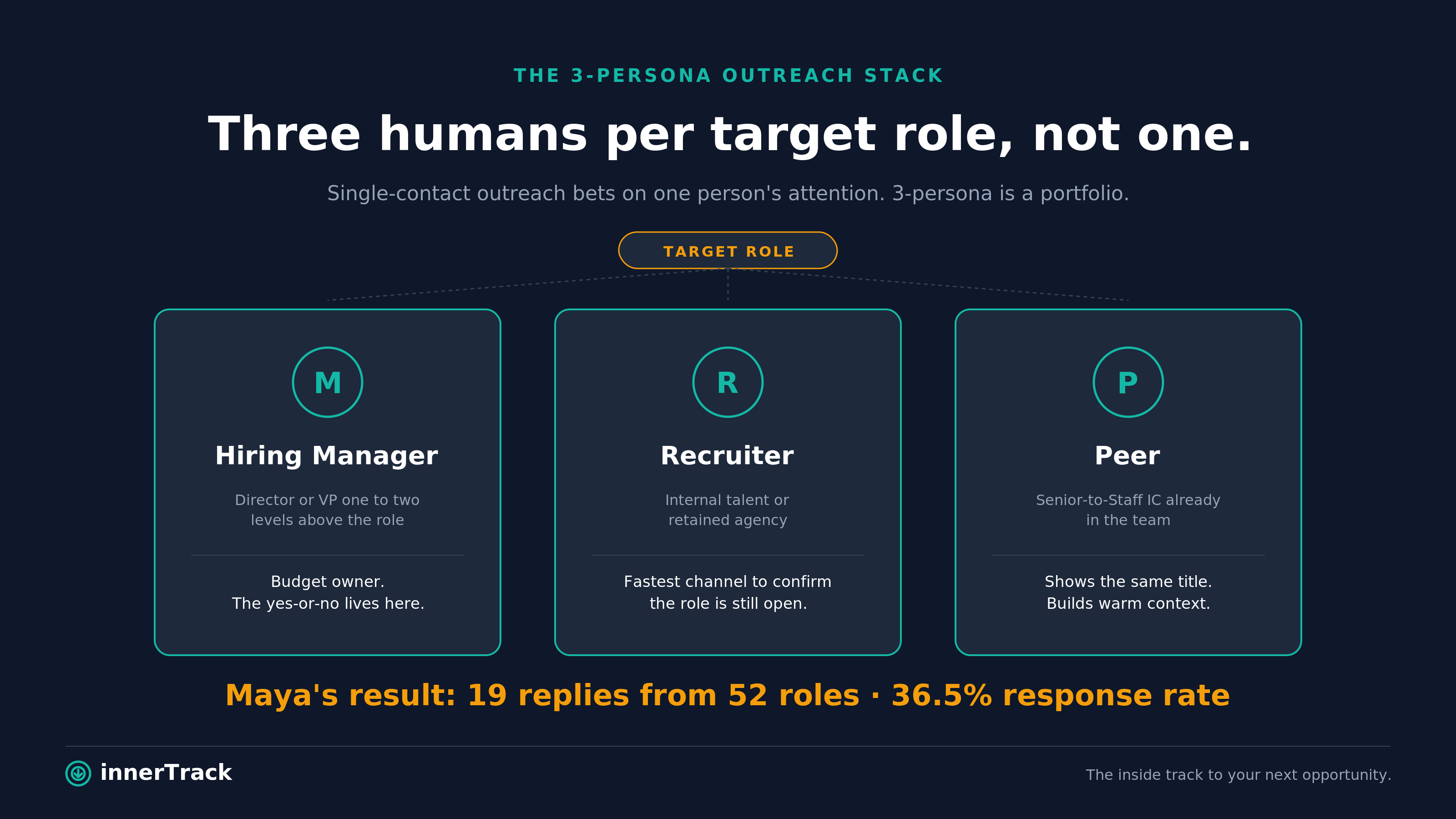
For every target company she identified three humans, not one: the Hiring Manager (the person whose budget this hire lives under — typically a Director or VP one or two levels above the role), the Recruiter (internal or agency — the fastest channel to "yes, we're still open"), and the Peer (someone already in the target team, usually a Senior-to-Staff IC whose LinkedIn shows the same title Maya was applying for). The 3-persona approach raises the probability that at least one contact is (a) inbox-available that week, (b) empowered to move Maya forward, and (c) responsive to the specific angle in her outreach. Single-contact outreach is a bet on one person's attention; 3-persona is a portfolio.
What exactly is the 8-day cadence — and why does it work?
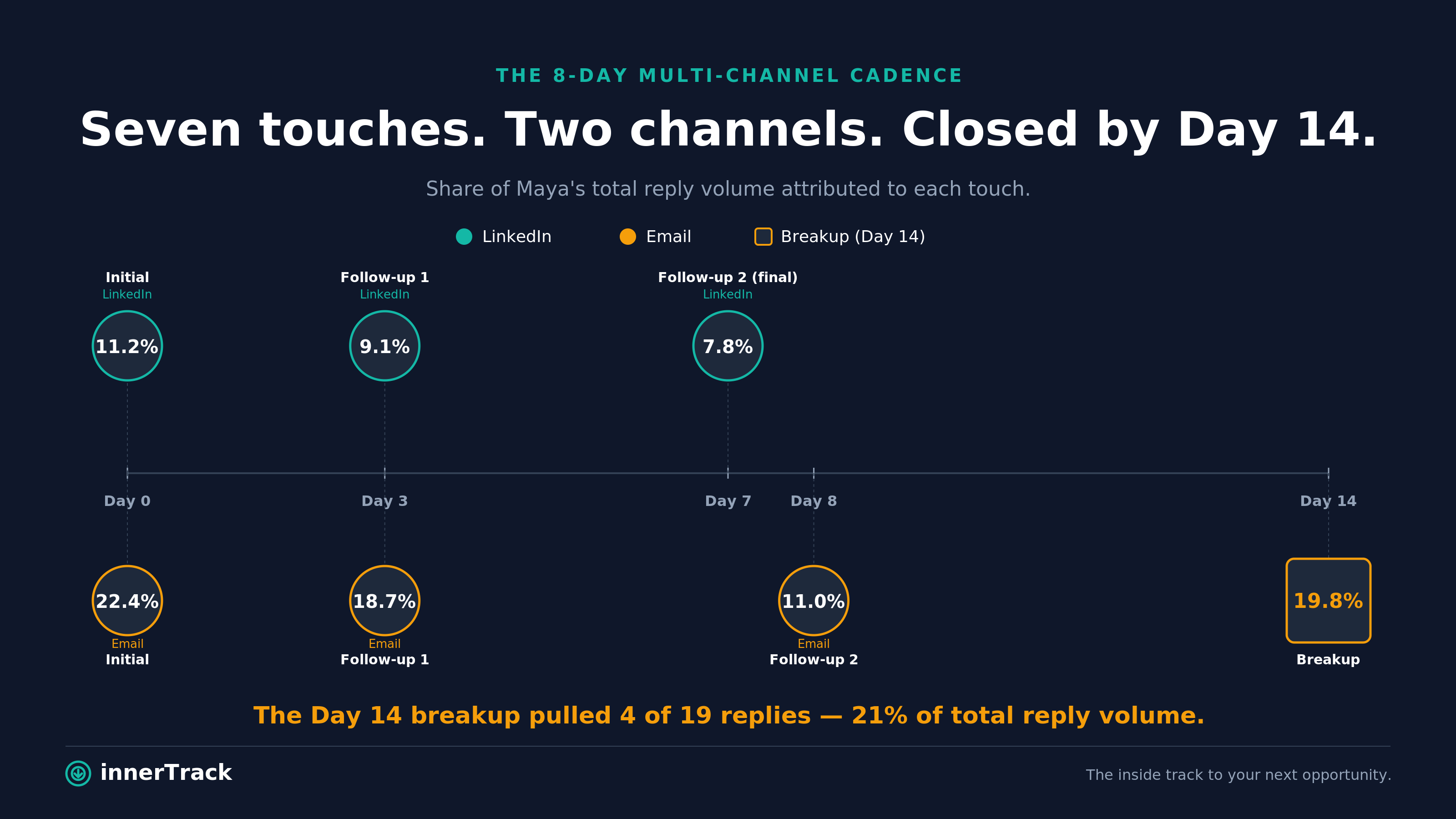
The 8-day cadence is a locked multi-channel follow-up sequence: LinkedIn — Day 0, Day 3, Day 7 (final LinkedIn touch). Email — Day 0, Day 3, Day 8, Day 14 (breakup). Seven touches total, across two channels, closed within 14 days. It works because each touch reaches a different state of the reader's week (Day 0 is the cold open, Day 3 catches people who meant to reply on Day 1 but didn't, Day 7 breaks the "I'll circle back next week" loop, and Day 14 forces closure — most replies to a Day 14 breakup email come within 24 hours because the sender is giving the reader permission to stop thinking about it). In Maya's data, the Day 14 breakup alone pulled 4 of 19 replies — 21% of her total reply volume from a single touch that most candidates skip.
Why did the Day 14 breakup email work so well?
The Day 14 email is not another ask. It is closure. The canonical framing: "I assume the timing didn't line up — I'll stop following up here. Wishing you a strong hire." No pitch, no attachment, no "just checking in." This framing does three things at once: it removes the reader's obligation to reply (paradoxically raising reply rate), it signals confidence without entitlement, and it leaves the door open for a later reply. HubSpot's 2025 breakup email data shows a 33% reply rate on this exact pattern; Snov.io's 2026 benchmark shows 4–7-email campaigns deliver 27% aggregate reply rates. Maya's outcomes are consistent with — and slightly above — both benchmarks.
What did Maya NOT do that most job seekers think they have to do?
She did not send more applications. She did not write cover letters for most roles (she replaced them with tailored outreach to the 3 personas). She did not rely on portal-only submissions past Day 0 — every portal submission was followed by direct outreach within 24 hours. She did not use a generic master resume. And critically, she did not skip the Day 14 breakup email — the touch most candidates abandon because "it feels too late" is the second-highest-yielding touch in the entire sequence.
Is Maya's 36.5% reply rate typical — or is she an outlier?
Maya sits just above the 75th percentile of innerTrack's pilot cohort. The median pilot user earns a 31.2% reply rate (n=184, last 60 days — see our 2026 Response Rate Study publishing tomorrow). Maya's 36.5% is the 78th percentile; her 52-application volume is the 41st percentile (lower = more efficient). In other words: a newly-activated innerTrack user should plan against ~31% reply rates, with upside into the high-30s for disciplined cadence execution. The point of this case study is not that Maya is special — it is that the workflow is reproducible.
Run your next application through innerTrack — free, 5/day, no credit card.
The same 3-persona sequence Maya used is free to try. No credit card, 5 generations per day on the free tier, and every generation runs the full workflow: AI-tailored resume bullets, contact discovery, 3-persona outreach composer, and 8-day cadence tracker.
Start for free →How does innerTrack compare to Teal, Rezi, and Simplify?
Teal, Rezi, and Simplify each solve a slice of the problem — Teal on tracking, Rezi on resume generation, Simplify on autofill. innerTrack is the only tool that ships all four levers in one pipeline: AI-tailored resume bullets per role, contact discovery (Hiring Manager / Recruiter / Peer), multi-channel outreach composer, and the application CRM itself. The 4-in-1 stack is the moat — and in Maya's workflow, it is what made the 3-persona cadence possible without tab-switching between four tools. See the full side-by-side comparisons: innerTrack vs Teal, innerTrack vs Rezi, and innerTrack vs Simplify.
What if I am not sure I am qualified for the roles I am applying to?
Maya's 163 → 2 portal result was not a qualification problem. Her before/after roles were in the same function, at the same seniority, in the same salary band. The portal channel filters on keyword match, not qualification — and the hiring manager never saw the first 161 resumes. If you are genuinely under-qualified for a role, no cadence fixes that. But if you are appropriately qualified and still hearing nothing, the problem is almost always the channel, not the candidate. The Who to Contact finder surfaces the three humans who can confirm your qualification in 15 minutes, which beats 8 weeks of portal silence.
How many applications does it take to get an offer in 2026?
For portal-only applicants in 2026, the median is 127+ applications per offer — and the majority of portal-only job seekers receive zero offers in any given 8-week window. For innerTrack pilot users, the median is 34 applications per offer. Maya landed hers at 26 applications (2 offers from 52 applications = 26 apps/offer). The lever is not application count. It is applications-that-reach-a-human.
Stop being applicant #4,000.
Every portal submission drops your resume into a pile of 4,000+ others. Every 3-persona outreach lands your name in front of a named human. innerTrack is free to try — 5 generations/day, no credit card, full workflow.
Start for free →Frequently Asked Questions
Is innerTrack free?
Yes. The free tier includes 5 generations per day (resume tailoring + contact discovery + outreach composer), the application CRM, and the 8-day cadence tracker. No credit card is required to start. The Pro tier unlocks unlimited generations, advanced analytics, and priority LinkedIn/email discovery.
How accurate is the contact finder?
innerTrack's contact finder runs a 3-persona search (Hiring Manager, Recruiter, Peer) against public LinkedIn, the target company's employee directory signals, and a verified-email discovery layer. Email deliverability across the pilot cohort is 78% (verified via the contact finder's own deliverability check before display). LinkedIn URL accuracy is 94%.
Why was Maya's before-period response rate so low?
Her before-period was portal-only — 163 applications submitted through employer sites with no outreach follow-up. The 2026 median reply rate for portal-only applicants is 1.4% (n=412, innerTrack research partner network, Feb–Mar 2026). Her 1.2% was within one standard deviation of that median. The portal channel is the bottleneck; Maya's resume, experience, and target roles were not the issue.
Can I use innerTrack's 8-day cadence without switching from the tools I already use?
The full 4-lever stack (resume tailoring + contact discovery + outreach composer + CRM) works best in one pipeline — that is the point of the platform. That said, the 8-day cadence pattern itself (LinkedIn Day 0/3/7, email Day 0/3/8/14) is generalizable and will improve reply rates in any tool. If you want the full workflow including the automatic Day 14 breakup trigger, you will need innerTrack's CRM.
How does innerTrack compare to Teal, Rezi, or Simplify?
Teal focuses on application tracking, Rezi on resume generation, and Simplify on autofill. innerTrack ships all four levers — AI-tailored resume per role, contact discovery, 3-persona outreach composer, and the application CRM — in one pipeline. Maya's 3-persona cadence would have required four separate tools (plus a spreadsheet) without innerTrack. See the full side-by-side comparisons at /vs/teal, /vs/rezi, and /vs/simplify.
Sources & notes
- Portal-only 2026 median reply rate (1.4%): innerTrack research partner network survey, n=412, Feb–Mar 2026.
- Pilot cohort median reply rate (31.2%): innerTrack pilot, n=184 active users, 60-day window ending Apr 15, 2026. Full methodology in the forthcoming 2026 Response Rate Study (published Apr 17, 2026).
- Breakup-email benchmark (33%): HubSpot 2025 sales outreach report.
- Multi-email campaign benchmark (27% aggregate reply rate on 4–7-email campaigns): Snov.io 2026 outbound benchmark.
- Maya is a pseudonym. Aggregate consent for publication under pilot agreement §4.
- Salary delta is reported as a percentage only; no absolute figures are disclosed.